MATT's Top 20 films of 2013 - Part 1 - #5 to #1
 5. - STRAY DOGS (Jiao You) by Ming-Liang Tsai
The portrait of a family in Taiwan that lives in a certain state of decadence. This film will split the audience in half. While some will never stop praising it, others will quite simply have no time for it. Its reliance on lengthy uneventful and still shots as well as a narrative that seems to go nowhere will frustrate many viewers. But then again, this film is not for everyone and that is part of its appeal.
Tsai Ling-Miang moves at his own pace and doesn’t seem to be interested in shifting away from his still and challenging style. Stray Dogs is, whether people like it or not, a truly magnificent vision and a purifying experience. Very often as an audience we are used to the camera pointing at a subject only if that subject will do something or interact with an object in some way. Here, the opposite happens most of the time, and the audience is hence led to interact with the scenes and lack of action in a subconscious and unique way. Yet, the intensity of the lack of action is powerful in its own unique way.
In a sense, with Stray Dogs in particular, Tsai Ling-Miang re-invents the cinematic language but the perception of its beauty and its emotion relies on the will of the viewer to tag along for the ride and be transported by this hypnotising and stunning film. Of course, Stray Dogs heavily hints at serious themes, like the decadence and frustration of modern culture, but on a human level it is just as intense.
 4. - THE GREAT BEAUTY (La Grande Bellezza) by Paolo Sorrentino
An ageing writer, and one of the main figures in the Roman social scene of huge parties, bitterly recollects lost love and lost youth.
There is no doubt about it - The Great Beauty is this generation's La Dolce Vita as a bittersweet representation of modern society and alienation as well as an inevitable descent into emptiness through endless flirtations of immorality. Here, in Sorrentino's film, the lead character is aged and looks onto his once promising career and life as a wasted opportunity as he methodically walks through his self-writter set of rules that have made him a king of Rome's vital and extravagant social life. To do this, the director collaborated once again with Toni Servillo, whose performance is perfectly restrained and collected.
Furthermore, he employs a spectacularly constructed style of camerawork which heightens the film's beauty, although sometimes to excess,`in an overall glorious work of decaying glamour and celebrated confidence.
 3. - LIKE FATHER LIKE SON (Soshite chichi ni naru) by Hirokazu Koreeda
The lives of two very different Japanese families are shaken when they discover six years later that a mix up in a hospital inadvertently swapped their two male babies. This bombshell inevitably leads to much psychological and emotional distress on both sides of the story, and especially in the father of one of the families who is led down a road of deep and meaningful re-evaluations of fatherhood as well as reflection own struggles with exposing his own emotions.
After dealing with the separation of a pair of young siblings in his previous work I Wish, Kore-eda returns to the domestic drama territory in a profoundly moving film. However, apart from the story and thought provoking discourse, which also carefully contrasts family traditionalism with modernism, the filmmaker also employs a tasteful kind of style in bringing the story to the screen which is tastefully defined and doesn’t shift the attention away from the intimacy of the meditative nature of Like Father, Like Son and its difficult themes.
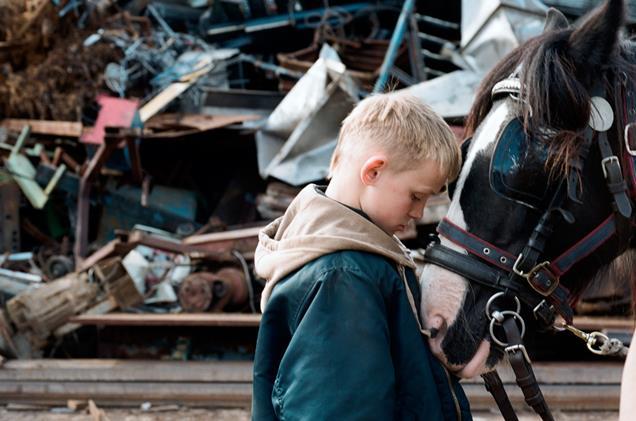 2. - THE SELFISH GIANT by Clio Barnard
Clio Branard draws inspiration from the famous Oscar Wilde work to tell the story of two teenage boys caught in the world of copper theft.
The Selfish Giant is a story of the friendship and strong bond between two young boys, which feels a lot like a moving representation of platonic love. However, it is also a truly powerful drama about the state of kids in underprivileged areas of Britain and a reflection on the passive educational system of the United Kingdom.
Barnard draws you inside this unappealing and dirty world in an ultimate display of the anti-fable. In doing so she employs a realist style, not unlike the best works on social commentary by Ken Loach, that makes the film all the more impactful and ultimately haunting. Barnard was also able to inspire great performances in the two leads, who had never acted before but give genuinely strong performances and share great on screen chemistry, a chemistry which was needed to make their story not only believable but also as intense as it is.
1. - BLUE IS THE WARMEST COLOR (La vie d'Adèle) by Abdellatif Kechiche
Blue is the Warmest Color is much more than the sexually explicit film its controversial nature would have you believe. Director Kechiche knocks down conventional boundaries to truly examine the passion of the love story between two young women, Adele and Emma, from their schooldays to their young adulthood.
While it was based on a graphic novel, a lot of Kechiche’s own concerns with class and society are represented in this film. And while it is true that the sex scenes are lengthy, steamy and imaginative it is equally true but not as acknowledged that the scenes where the girls converse are equally as long and allowed to breathe. This is a technique that truly reveals the most intimate details of the romance between the two central figures in Blue is the Warmest Color and helps establish a fresh kind of connection with a modern audience, which nevertheless does not spare us - or indeed ever tried to spare us - from the truth of romanticism and relationships that goes from pain to pleasure within the blink of an eye.
While the film occasionally suffers from its share of overzealousness, it is truly remarkable how the film can remain absorbing despite its length of over three hours.
Lead actresses Adéle Exarchoupoulos and Léa Seydoux deliver praiseworthy very brave performances, which were of vital importance to give the film the right kind of credibility. Furthermore, with their beauty, sexual chemistry and tenderness they have all the potential to become modern cultural icons of romanticism whether the censorship boards like it or not.